
Britain's Political and Economic Direction


Party conferences are often judged by their biggest announcements. But the more revealing question is why certain announcements are being made, what problems they are designed to solve, and what they tell us about the thinking inside each political party.
Across Reform, the Conservatives and Labour, this year's conferences exposed three different responses to the same challenge: Britain needs to generate growth, but the traditional levers of taxation, public spending and borrowing are increasingly constrained.
What stood out across conference season was not simply the differences between the parties, but the pressures shaping their decisions.
Reform: from political disruption to economic credibility
Perhaps the most revealing development at Reform's Business Day was not a tax announcement. It was Robert Jenrick's discussion of engagement with gilt investors in London and New York.
That matters because Reform appears to recognise that winning political support and winning financial-market confidence are different challenges.
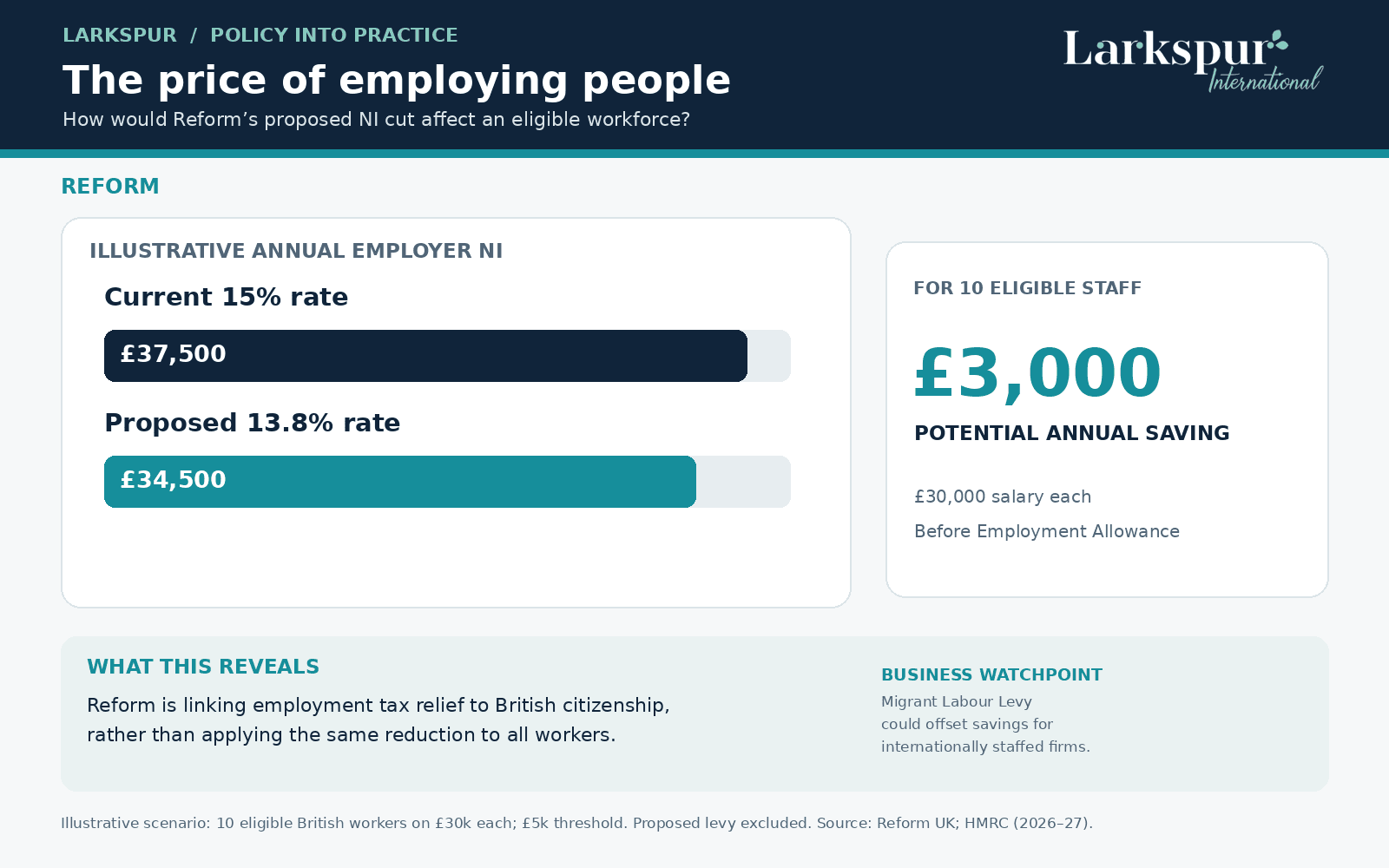
Its ambition to reduce government spending substantially, raise the income tax personal allowance to £15,000 and increase the VAT threshold to £150,000 is designed to appeal to households and smaller businesses feeling squeezed by the cost of the state.
But the discussion with bond investors signals something deeper: Reform knows that an ambitious programme of tax reductions and structural change must convince the markets financing Britain's debt.
Its energy position follows a similar logic. Opposition to renewable subsidies, carbon pricing and elements of the Net Zero framework is not simply ideological. Reform is positioning energy costs as a fundamental explanation for Britain's declining industrial competitiveness.
There is also a political calculation. Cheaper energy, domestic manufacturing and resistance to international regulatory alignment speak to industrial communities and businesses that feel poorly served by the current economic settlement.
The direction is becoming clearer: Reform wants to be seen not only as a challenger to the political establishment, but as a credible alternative for governing the economy.
The difficulty is that unwinding existing energy policies and contracts could introduce precisely the kind of investment uncertainty it wants to remove. How Reform reconciles those competing objectives will reveal much about the next stage of its programme.
Conservatives: rebuilding trust through economic restraint
The Conservatives' £71 billion savings plan, with £35.5 billion reserved for deficit reduction, arguably tells us more about the party's current thinking than its individual tax-cutting promises.
This is an attempt to restore a reputation for fiscal discipline while rebuilding the party's traditional identity as the champion of enterprise and lower taxation.
The decision to allocate half the proposed savings to deficit reduction is particularly significant. It is a recognition that tax cuts alone are not sufficient to reassure voters or financial markets. They must be accompanied by an explanation of how they will be funded.
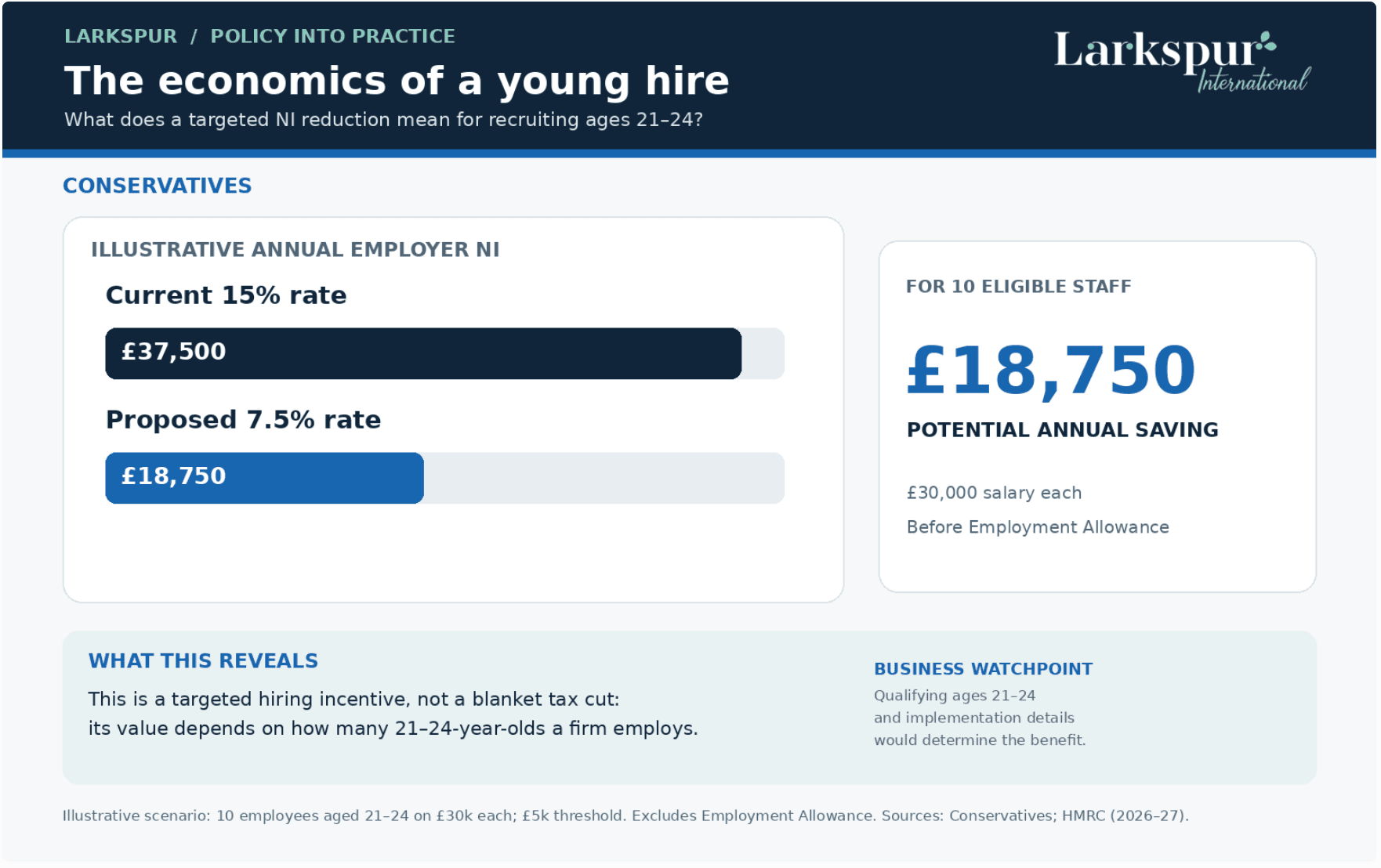
The proposal to halve employer National Insurance from 15% to 7.5% for employees aged 21–24 is also revealing.
Rather than promising an immediate reduction for every employer, the Conservatives have targeted a specific problem: the rising cost of recruiting younger workers at a time of concern about youth unemployment.
Similarly, proposals to replace IR35, simplify taxation and reduce regulatory obligations indicate that the party increasingly sees the cumulative cost of compliance as a barrier to business expansion.
Discussions at SME Business Day added another dimension: Britain's difficulty in retaining and scaling the businesses it creates. The interest in pension capital, domestic investment and defence procurement suggests a recognition that tax reductions alone cannot solve Britain's productivity and scale-up challenges.
The Conservatives are trying to combine a smaller-state philosophy with a more credible explanation of how Britain can finance and sustain growth.
Their challenge will be demonstrating that planned spending reductions can coexist with the infrastructure, public services and institutional capacity on which businesses also depend.
Labour: industrial strategy is becoming political strategy
Labour's conference offered perhaps the clearest indication of how the Government now understands its economic and political challenge.
The striking feature was how closely industrial investment, employment, regional development and technology were being connected.
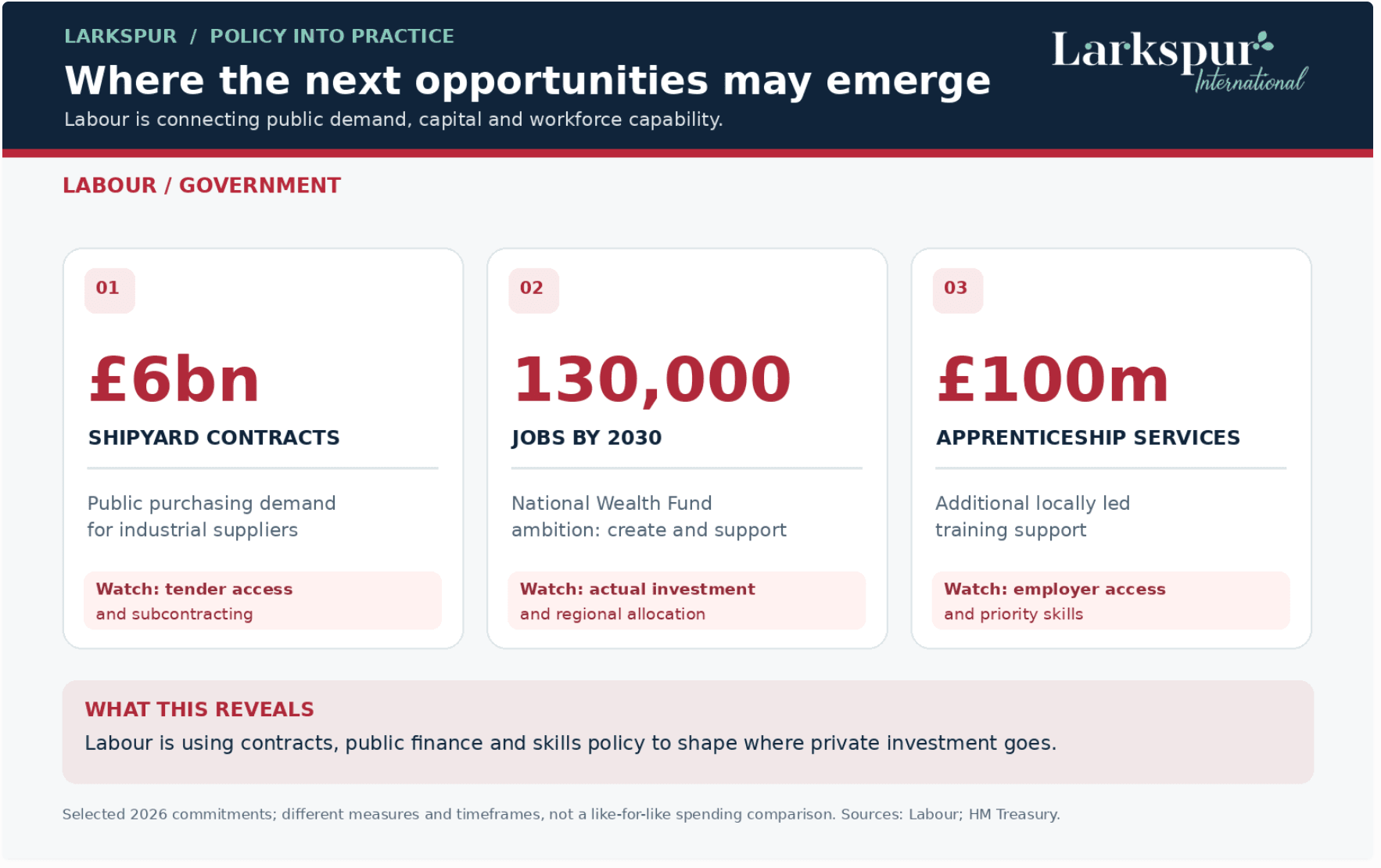
Consider the commitment to £6 billion of work for British shipyards, the National Wealth Fund's ambition to create and support a further 130,000 jobs by 2030, and the additional £100 million for locally led apprenticeship services.
These are not simply separate spending commitments.
They reflect a Government seeking to demonstrate that economic growth can be felt in communities which have experienced decades of industrial decline.
There is an important political dimension here. Labour needs growth, but it also needs people to see where that growth is happening, who benefits and whether it creates secure, well-paid employment.
That helps explain the emphasis on domestic procurement, regional investment and British industrial capability. Defence spending is being presented not only as a national security requirement but as an opportunity to rebuild supply chains, skills and manufacturing capacity.
AI fits into the same thinking.
One line from our time at Conference stayed with us:
"AI won't take your job. But someone who knows how to use AI will."
It captures the Government's attempt to reconcile two pressures: the need for technological productivity gains and the fear that technological change will leave workers behind.
The renewed Union Learning Fund, with £15 million annually, is therefore more than a training announcement. It suggests Labour wants workers and trade unions to be participants in technological transformation rather than opponents of it.
There is a further reason for this approach. With limited fiscal headroom, the Government cannot fund industrial renewal through public spending alone. Institutions such as the National Wealth Fund and British Business Bank are intended to attract private capital, while procurement creates demand that can encourage businesses to invest.
Labour is attempting to use the state's purchasing power, financing institutions and regional relationships to influence where private investment goes and who benefits from it.
The question is whether this can deliver results quickly enough, particularly while businesses continue to face pressures from employment costs, energy prices and regulation.
What the conferences really tell us
Look beyond the political language and an interesting pattern emerges.
All three parties recognise that Britain's economic problem is not simply a lack of entrepreneurs or innovation. It is the difficulty of turning those strengths into productive investment, competitive industries and sustained growth.
But each is responding to a different political pressure.
Reform needs to demonstrate that radical change can be financially credible. The Conservatives need to show that their economic programme is both affordable and distinct. Labour needs to prove that active government can deliver tangible improvements in people's lives.
These pressures help explain why the parties are prioritising different policies, even when they agree about the underlying problems.
For business, the implications are significant.
Under Labour, opportunities are increasingly likely to emerge where industrial strategy, public procurement, private finance and regional priorities intersect. The Conservatives are signalling potential changes to employment costs, tax administration and regulation. Reform is indicating more fundamental changes to energy markets, public spending and the UK's economic relationship with Europe.
The detail will evolve, but the direction of travel is becoming more visible.
And perhaps that is the most valuable insight from conference season.
The announcements tell us what each party wants businesses to hear. The choices behind those announcements tell us what each party is worried about, what it believes will drive growth, and where it is likely to move next.
For businesses making long-term decisions, understanding those motivations may prove considerably more valuable than the headline promises themselves.