
UK Autumn Budget 2026: What Does It Mean for Businesses and Industries Across the UK?


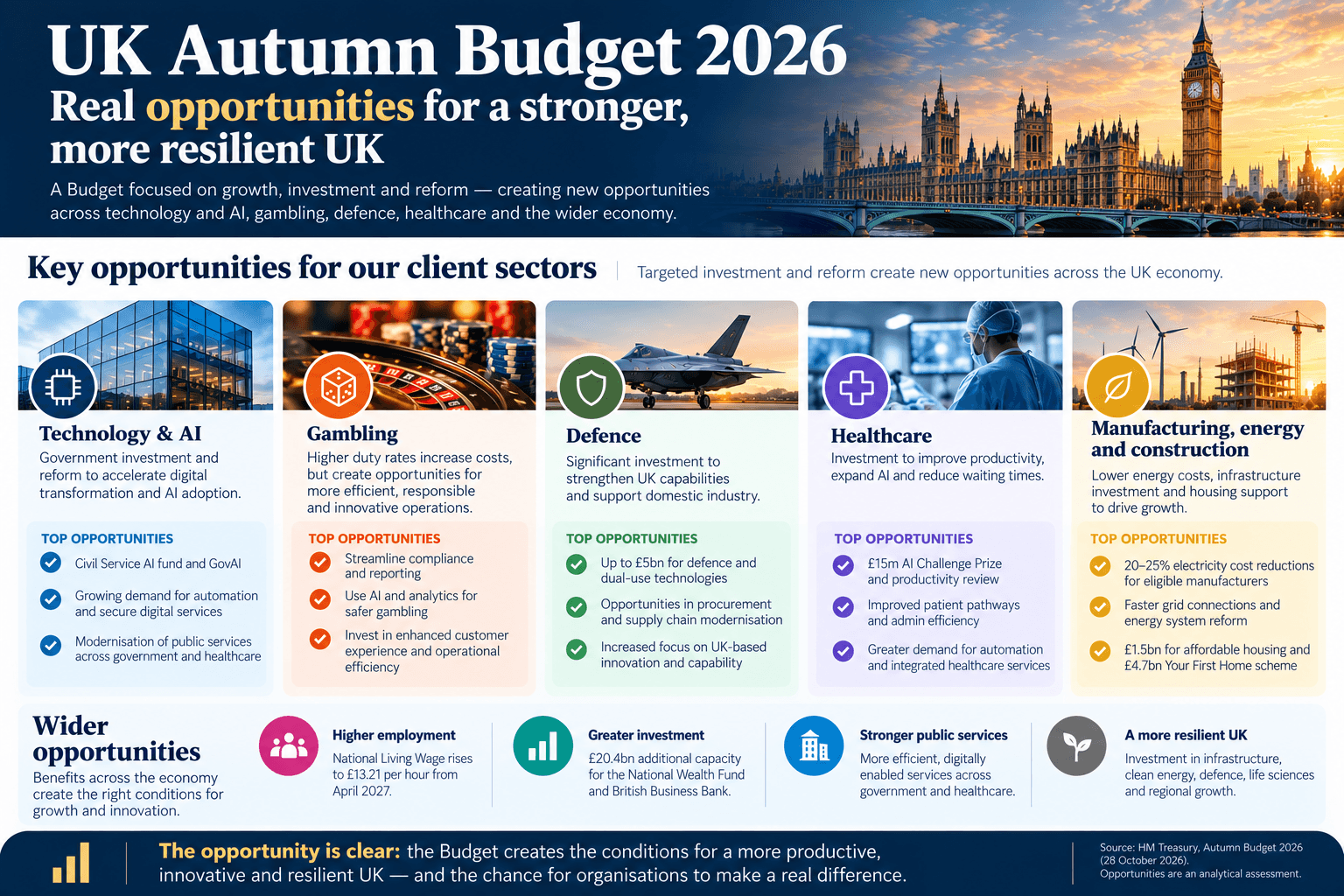
From energy costs and business taxation to housing, manufacturing and investment, the Autumn Budget 2026 introduces measures that could shape the UK's economic outlook. But which industries stand to benefit, and where do challenges remain?
The UK Autumn Budget 2026 comes at a time of continued economic uncertainty, rising costs and pressure on public finances.
The Chancellor's announcements seek to balance immediate financial support for households and businesses with longer-term investment in infrastructure, innovation and economic growth.
With the Office for Budget Responsibility forecasting growth of just 1.0% in 2027, the government faces the challenge of stimulating investment while maintaining fiscal stability.
For businesses, the Budget presents a mixture of opportunities, additional costs and changes that could influence investment decisions over the coming years.
Energy: Lowering costs for households and businesses
Energy remains a central priority, with the government announcing a £100 Household Energy Payment for eligible households, an extension of electricity VAT relief and reforms to reduce standing charges.
For businesses, the focus is on improving competitiveness through lower energy costs and more reliable infrastructure.
The British Industrial Competitiveness Scheme is expected to provide electricity cost reductions of 20–25% for around 10,000 eligible manufacturing businesses from April 2027.
This could offer significant support to energy-intensive industries, including manufacturing, chemicals and steel.
However, delivering lasting savings will depend on investment in energy generation, infrastructure and faster grid connections.
Retail and hospitality: Relief for the high street
The Budget introduces targeted business-rate support for retail, hospitality and leisure businesses.
From April 2027, changes to Small Business Rate Relief are expected to remove approximately 70,000 additional businesses from paying business rates, while other eligible businesses will benefit from a two-year real-terms freeze.
This could provide welcome relief for independent retailers, pubs, restaurants and other high-street businesses.
However, higher employment costs remain a challenge. The National Living Wage will rise to £13.21 per hour from April 2027, increasing costs for labour-intensive sectors.
For many businesses, the key question will be whether lower business rates and improved consumer spending can offset continued pressure on wages and operating costs.
Financial services and business investment: A mixed picture
The financial services sector faces additional taxation, including a temporary increase in the Bank Corporation Tax Surcharge from 3% to 6% for 15 months.
Changes to savings and property income taxation will also affect some investors and property owners.
At the same time, the government is seeking to encourage business growth through an additional £20.4 billion in financial capacity for the National Wealth Fund and British Business Bank.
This could improve access to finance for businesses looking to expand, innovate or invest in strategic industries.
Entrepreneurs may also benefit from a new Founders' Relief, offering a 10% Capital Gains Tax rate on up to £10 million of qualifying lifetime gains.
However, the reduction in the existing Business Asset Disposal Relief lifetime limit means the changes will not benefit all business owners equally.
Housing and construction: Supporting supply and home ownership
The government has announced an additional £1.5 billion for social and affordable housing, taking the overall programme beyond £40 billion.
A new £4.7 billion Your First Home scheme will also support first-time buyers through government-backed equity loans.
For construction companies, property developers and their supply chains, these measures could create opportunities for new projects and increased demand.
Nevertheless, planning delays, labour shortages and rising construction costs remain significant obstacles to increasing housing supply.
Manufacturing, life sciences and defence: Investment in strategic industries
The Budget places considerable emphasis on strengthening the UK's industrial capabilities.
More than £1 billion in planned private-sector life sciences investment has been highlighted, alongside support for advanced manufacturing and next-generation aerospace technology.
Defence is another area of focus, with commitments to fund the Defence Investment Plan and expand financing for defence and dual-use technologies.
These measures could create opportunities for manufacturers, engineering companies, research organisations and businesses operating within defence supply chains.
The government's focus on domestic production and national resilience may also encourage businesses to strengthen their UK operations and investment.
Public services and regional growth: A focus on efficiency
The Budget includes plans to give local authorities greater financial responsibilities and expand regional investment.
For businesses, this could create opportunities in infrastructure, housing, regeneration and local service delivery.
Meanwhile, central government departments are expected to reduce administrative spending by 20% in real terms by 2029–30.
Investment in artificial intelligence, automation and digital transformation will play a role in meeting these efficiency targets, particularly across the Civil Service and NHS.
For companies such as Pegasystems, this creates opportunities to help organisations modernise operations, improve service delivery and reduce administrative costs.
However, new government procurement policies, a greater emphasis on British suppliers and requirements around data security will also shape how technology companies compete for public-sector contracts.
What does the Budget mean for UK businesses?
Overall, the Autumn Budget 2026 offers targeted support across several important sectors, but its impact will vary.
Energy-intensive manufacturers could benefit from lower electricity costs, while retailers and hospitality businesses may welcome reductions in business rates.
Housing, defence and life sciences could see increased investment, while financial services and some employers face additional tax and cost pressures.
The wider challenge is translating these announcements into meaningful economic improvements.
Many of the measures will take time to implement, and businesses must continue to navigate inflation, regulation, skills shortages and economic uncertainty.
Looking ahead
The Autumn Budget 2026 sets out an ambitious approach to strengthening the UK's competitiveness, supporting key industries and improving public-sector productivity.
For businesses, it presents both opportunities to invest and grow, and challenges that will require careful planning.
Ultimately, the success of the Budget will depend not simply on the funding announced, but on whether these measures deliver greater business confidence, higher productivity and sustainable economic growth.
Sources and further reading
HM Treasury- Autumn Budget 2026
Office for Budget Responsibility
HMRC - Budget 2026 Tax Legislation and Rates
Based on the announcements of 28 October 2026. Some measures remain subject to legislation, consultation and further implementation details.